
Flipped Learning 3.0 (FL3.0) changes not only where learning takes place, but also how learners participate in the learning process. Adult learners prepare individually, enter group learning with prior knowledge and questions, apply what they have learned, collaborate with others and reflect on their progress.
For some adults, this way of learning may initially be unfamiliar. This does not mean that they are unsuitable for Flipped Learning. Often, difficulties arise when learners are expected to work independently without sufficient structure, connection and support. The use of two different learning spaces, the Individual Learning Space (ILS) and the Group Learning Space (GLS), may be challenging the learners.
Good FL3.0 design therefore does not simply demand greater independence. It creates the conditions in which adult learners can gradually become more confident and independent.
Time and competing responsibilities
Adults often balance learning with work, family and other responsibilities. The flexibility of the Individual Learning Space (ILS) can therefore be a major advantage. However, flexibility can also make learning easy to postpone.
The problem is not always poor time management. Preparation activities may also be too long, unclear or unrealistic for the learners‘ circumstances.
Practical ways to support learners
- Realistic workload: keep preparation manageable and appropriate for the target group.
- Clear time indications: tell learners approximately how long an activity should take.
- Short, structured activities: several manageable steps are often better than one long learning task.
- Clear expectations: make it clear that preparation is an integral part of the course.
- Visible learning paths: show learners what they need to complete and what comes next.
- Clear connection to the GLS: learners should understand how their preparation will help them during the group session.
Digital and learning-space uncertainty
For some adults, the challenge is not the subject itself but the digital learning environment. They may be unfamiliar with a learning platform, interactive videos, online quizzes or other digital activities. However, technical skills are only one part of the challenge. Even digitally confident adults may not know how to learn effectively in an Individual Learning Space.
Learners therefore need both technical orientation and orientation in the learning process.
Practical ways to support learners
- Reduce digital entry points: use only the tools that genuinely contribute to learning.
- Principles before platforms: explain how the learning process works, not only where learners need to click.
- Guided orientation: introduce the ILS and explain the purpose of its main elements.
- Accessible learning materials: avoid unnecessary technical barriers and ensure that materials work on commonly used devices.
- Low-risk practice: allow learners to become familiar with the digital environment before important activities begin.
- A positive culture around mistakes: digital uncertainty should be treated as a normal part of learning.
Unfamiliar learner roles and expectations
Many adults have experienced courses in which the trainer first presents the content and learners then practise it. FL3.0 changes this relationship. Learning often begins before the group session. Learners are expected to prepare, identify questions and bring their initial understanding into the Group Learning Space (GLS).
Some learners may therefore ask:
“Why should I study this before the session? Isn’t that what the course is for?”
This reaction should not be interpreted simply as resistance. Learners need to understand why the learning process is organised differently and what they gain from it.
Practical ways to support learners
- Explain the FL3.0 approach: introduce the learning model at the beginning of the course.
- Explain the benefit: show why preparation allows group time to be used for application, discussion, collaboration and feedback.
- Start gradually: begin with short and achievable preparation activities.
- Make success visible: help learners recognise how their preparation improves their participation in the GLS.
- Clarify responsibilities: explain the roles of both learners and trainers in the learning process.
Cognitive overload and uncertainty in the ILS
Learners may feel uncertain when they encounter new material independently. They may wonder:
“Have I understood this correctly?”
or:
“Am I expected to understand everything before the group session?”
A well-designed ILS should not leave learners alone with large amounts of content. Nor does every learner need to master everything before entering the GLS.
The purpose of preparation is to establish a useful foundation for active learning together.
Practical ways to support learners
- Guided learning paths: organise content into clear and manageable steps.
- Transparent learning goals: explain what learners should know or be able to do after each activity.
- Focus on essential preparation: include what learners genuinely need for the following GLS activities.
- Short formative checks: use questions and small tasks to help learners check their understanding.
- Useful feedback: explain why an answer is correct or incorrect instead of only displaying a score.
- Opportunities to identify questions: encourage learners to bring uncertainties into the GLS.
The message should be clear:
Preparation does not mean that learners must understand everything alone. It prepares them to learn more effectively with others.
Difficulty with reflection and self-regulation
Reflection can play an important role in FL3.0 because it helps learners become more aware of what they understand, where they need support and how they learn effectively. However, many adults have little experience with structured reflection on their own learning. Reflection may initially feel abstract, personal or unnecessary. Reflection therefore needs to be introduced and practised like any other learning skill.
Practical ways to support learners
- Simple reflection prompts: use clear questions or sentence starters.
- Specific questions: ask about concrete learning experiences rather than requesting general reflection.
- Modelling by trainers: provide examples of useful reflection.
- Small-group reflection: pairs or small groups can make reflection easier.
- Connect reflection to action: use reflection to identify the next learning step.
- Develop the skill gradually: begin with short reflection activities and increase their depth over time.
Different levels of preparation in the GLS
(Unfortunately) Not all learners will enter the Group Learning Space with the same level of preparation. Some may have completed everything, others only part of the preparation, and some may have misunderstood important concepts. These differences can affect group dynamics. Well-prepared learners may feel slowed down, while less-prepared learners may feel lost or embarrassed.
The solution should not normally be to repeat the complete ILS content during the group session. If learners know that the trainer will explain everything again, preparation can quickly appear unnecessary.
Practical ways to support learners
- Short activation activities: begin with a brief task that activates essential prior learning.
- Targeted clarification: address important misunderstandings without repeating the complete ILS.
- Flexible activities: provide different entry points where appropriate.
- Structured peer learning: use methods such as peer explanation, Think–Pair–Share or collaborative problem-solving.
- Clear group roles: ensure that participation and responsibility are shared.
- Recovery opportunities: help learners regain essential knowledge without turning the GLS back into a lecture.
A useful sequence can be:
Activate → Compare → Clarify → Apply
Fear of mistakes and assessment
Some adult learners are uncomfortable with quizzes, self-checks and other assessment activities. They may interpret every question as a test and every incorrect answer as failure. In FL3.0, formative assessment can serve a different purpose. It can help learners identify what they already understand and where they need further learning. Mistakes can therefore provide valuable information for both learners and trainers.
Practical ways to support learners
- Separate practice from formal assessment: clearly identify activities that are designed for learning rather than grading.
- Use formative assessment: help learners check their progress before formal assessment.
- Allow repeated attempts where appropriate: encourage improvement rather than one-time performance.
- Provide explanatory feedback: tell learners why an answer is correct or incorrect.
- Use Learning-by-Assessment: design questions so that the assessment activity itself contributes to learning.
- Normalise mistakes: make clear that errors during learning are useful indicators of what to work on next.
Three Principles for Supporting Adult Learners
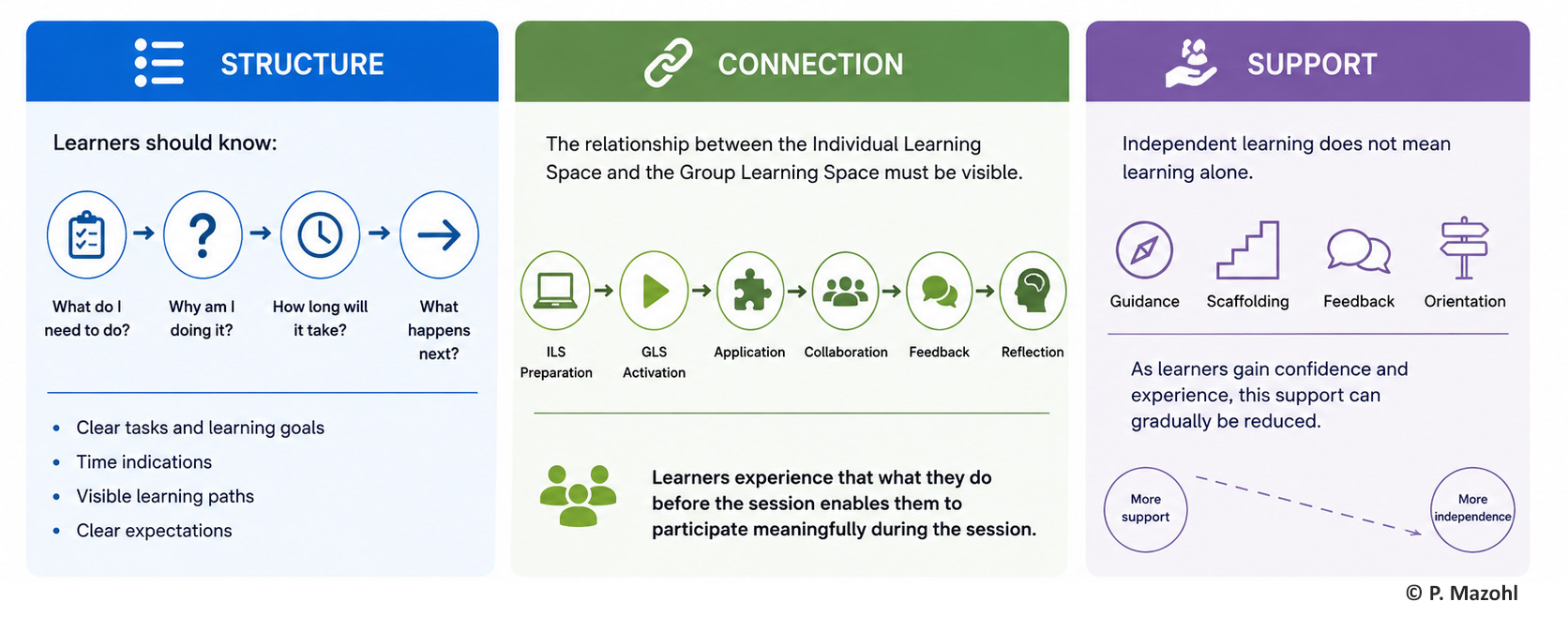
Across these challenges, three principles are particularly important for successful FL3.0 design:
- STRUCTURE
Learners should know:
What do I need to do? → Why am I doing it? → How long will it take? → What happens next?
- CONNECTION
The relationship between the Individual Learning Space and the Group Learning Space must be visible:
ILS Preparation → GLS Activation → Application → Collaboration → Feedback → Reflection
Learners should experience that what they do before the session enables them to participate meaningfully during the session.
- SUPPORT
Independent learning does not mean learning alone.
Trainers provide guidance, scaffolding, feedback and orientation. As learners gain confidence and experience, this support can gradually be reduced.
The aim of FL3.0 is therefore not simply to demand more responsibility from adult learners. It is to create a learning environment in which they can gradually develop the confidence, skills and independence needed to take a more active role in their own learning.