
The Professional Development sector focuses on the ongoing growth of educators who use Flipped Learning 3.0 in their teaching. It covers five key areas: continually developing your skills and knowledge, staying up to date with innovations, and taking part in both local and global communities of Flipped Learning educators. It also emphasises the importance of grounding your practice in current research. These areas support educators in staying effective, sharing good practice, and contributing to a wider culture of continuous improvement — both within their own institutions and across the international Flipped Learning community.
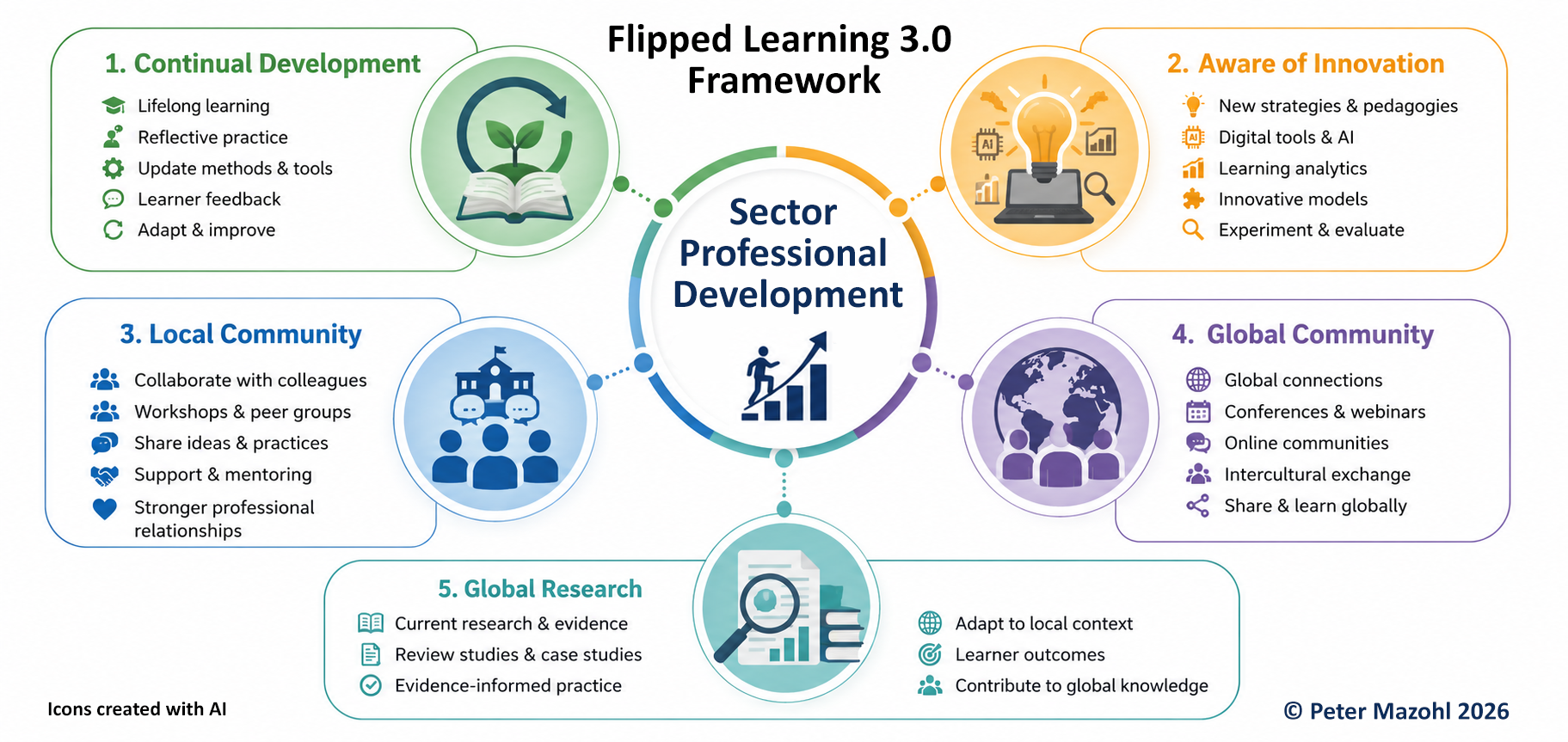
Visualisation of the elements of the sector Professional Development (of the Flipped learning 3.0 Framework)
Continual Development
BEST PRACTICE: Keep developing your Flipped Learning skills and knowledge continuously.
 Flipped Learning is an evolving field, and educators should commit to lifelong learning and reflective practice. Regularly updating teaching methods, exploring new tools, evaluating learner feedback, and reflecting on experiences help educators remain effective and adaptable in changing educational contexts. Continuous professional growth enables educators to respond to emerging learner needs, refine their instructional approaches, and foster a culture of continuous improvement. By embracing experimentation and learning from both successes and challenges, educators strengthen their capacity to provide meaningful and engaging learning experiences.
Aware of Innovation
BEST PRACTICE: Stay aware of current innovations in Flipped Learning.
 New strategies, technologies, and research findings continually shape the development of Flipped Learning. Educators should actively monitor emerging pedagogical approaches, digital tools, artificial intelligence applications, learning analytics, and innovative instructional models. Staying informed enables educators to critically evaluate new developments and adopt those that enhance learner engagement and achievement. An innovative mindset encourages experimentation, responsible use of technology, and the integration of evidence-informed practices that keep teaching relevant, dynamic, and future-oriented.
Local Community
BEST PRACTICE: Be active in a local community of Flipped Learning educators.
 Collaborating with colleagues within schools, institutions, regions, or professional networks fosters shared growth and collective expertise. Participation in local workshops, peer-learning groups, professional associations, and collaborative initiatives creates opportunities to exchange ideas, solve challenges, and share effective practices. Active involvement in local communities promotes mutual support, mentoring, and the dissemination of successful approaches. Strong professional relationships contribute to building a collaborative culture that enhances both educator development and institutional innovation.
Global Community
BEST PRACTICE: Be active in a global community of Flipped Learning educators.
 Engaging with educators around the world broadens perspectives and creates opportunities for intercultural exchange and international collaboration. Participation in global conferences, webinars, online communities, social media networks, and collaborative projects exposes educators to diverse educational contexts and innovative practices. Global connections encourage the sharing of experiences, foster mutual learning, and inspire creative solutions to common challenges. Being part of an international professional community strengthens global awareness and supports the continuous evolution of Flipped Learning practices.
Global Research
BEST PRACTICE: Base your practice on the most current global research.
 Research provides the foundation for effective and sustainable Flipped Learning practices. Educators should regularly review current studies, reports, and case studies to ensure that their approaches are evidence-informed and aligned with emerging knowledge. Critically interpreting research findings and adapting them to local contexts enables educators to make informed decisions that improve learner outcomes. Combining research evidence with practitioner experience, learner feedback, and reflective practice supports continuous innovation and contributes to the advancement of high-quality teaching and learning. By engaging with global research, educators become active contributors to an evolving international knowledge community.